The Clock is Ticking — Act by July 1 to Avoid “Not Secure” Warnings

Security, SSL Certificates

If you’ve been following website security industry changes, you may know that the move by browsers to warn visitors of webpages served via HTTP as “Not Secure” has been in the works for a while. And, if you’re like most organizations, preparing for the inevitable has been dead last on your to-do list. Unfortunately, pretending there’s no fire doesn’t mean you won’t eventually get burned.

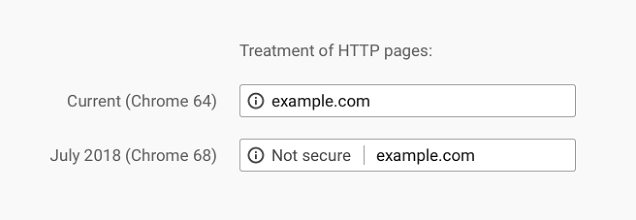
Implementation has been gradual and the end date has been moved out a few times but, according to the Feb. 8 announcement by Google, you’ll need to get an SSL certificate for all your webpages — not just the ones with login requirements or forms — by the time Chrome 68 launches. Starting July 2018, Chrome will universally alert visitors that land on any HTTP webpage. What began as a nudge from Google and Mozilla that only impacted pages with unencrypted password or text fields has become a no-exceptions requirement. We’re guessing this isn’t what you want your visitors to see.
Why HTTPS?

HTTP served Internet users well for many years. Unfortunately, given today’s cybercrime-ridden web, it has one crucial flaw — it’s not secure. That means data in transit can be stolen or manipulated.

HTTPS is secure and shows visitors https:// in the browser bar indicating encryption is authenticating the server and protecting transmitted information. So, it’s easy to understand why web browsers are now requiring it as a basic standard.

How do I get HTTPS?

SSL Certificates enable HTTPS — so the sooner you install one on all your webpages, the better. But, remember, website security is about more than encrypting data. Ensuring who’s on the other end of the data transfer is equally, if not more, important so making sure you have the right level of identity validation matters.

Choosing the right SSL certificate can be confusing, but it doesn’t have to be. We’re here to help you sort through your options and find the most cost-effective way to meet the July 1, 2018, deadline and boost your bottom line.

Update on CPU Security Vulnerabilities: Meltdown and Spectre

Security

You’ve probably already read about one of the most widespread security issues in modern computing history — colloquially known as “Meltdown” (CVE-2017-5754) and “Spectre” (CVE-2017-5753 and CVE-2017-5715) — affecting practically every computer built in the last 20 years, running any operating system.

Spectre and Meltdown are the names of the flaws found in a number of processors from Intel, ARM and AMD that could allow hackers to access passwords, encryption keys and other private information from open applications.

So far it doesn’t look like the Spectre or Meltdown flaws have been used in an attack, and device manufacturers are working with Intel, ARM and AMD to fix these flaws. The exploits can’t corrupt, modify or delete data.

Hopefully future processors should be free from the Spectre and Meltdown security flaws. So, don’t be too alarmed, but keep an eye on any updates your device offers.

We shall be patching our Shared Hosting and VPS/Dedicated Server infrastructure very soon. However, if you have VPS/Dedicated Server package(s) with us, please perform the updates fro your Operating System.

Please Note: Applying the patches may have a negative impact on overall performance.

Phase 1 of Google’s Plan to Mark Non-Secure Sites

Security, SSL Certificates

The release of Google Chrome 53 saw the first phase implemented in Google’s long-term vision of HTTPS becoming the internet standard. Eventually, every single website without SSL will have a red warning symbol with “Not Secure” next to it within the Chrome environment. For now, Chrome is marking all non-secure sites with an information radial that further explains a website has no encryption.

This will go a step further starting in January of 2017 for websites with password or credit card fields.

Be sure to get a Certificate for your website before it’s too late! We offer more than 70 different types of SSL Certificates starting from 9.75€/year w/o VAT.